Project Lifeline — Building Technology Around Community Health Work
One of the most meaningful projects I’ve had the opportunity to contribute to was a community health initiative focused on addressing health-related social needs (HRSNs) through community pharmacies and community health workers (CHWs).
The broader project later became part of a publication in the Journal of the American Pharmacists Association (JAPhA):
“Implementing a community health worker model to address health-related social needs in a community pharmacy network: A pragmatic evaluation.”
The program explored how community pharmacies could help identify and address non-medical factors that significantly affect health outcomes — including food insecurity, transportation barriers, housing instability, and other social determinants of health. The initiative involved pharmacies across New York State and evaluated both implementation outcomes and long-term sustainability. (japha.org)
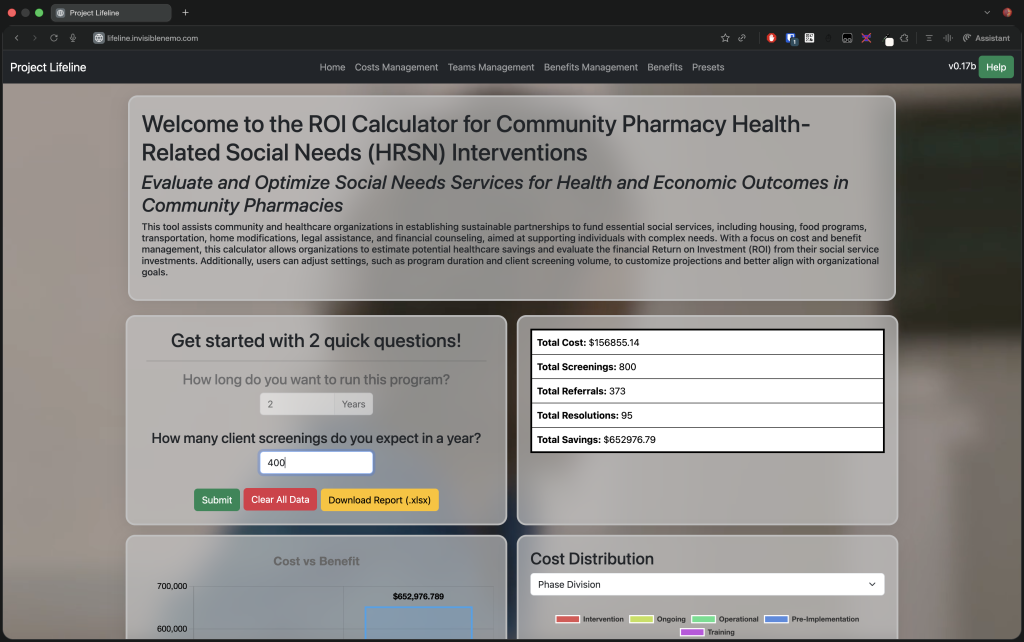
As part of the effort, I worked on building and deploying a lightweight web-based ROI and operational support platform called Project Lifeline.
The platform was designed to help estimate operational impact, projected costs, referrals, resolutions, and potential savings associated with HRSN screening and referral programs. The project documentation later referenced the online tool as part of the broader implementation work. (communitypharmacyfoundation.org)
From a technical perspective, the project was intentionally kept lightweight and accessible:
- publicly deployed using the free tier on Render
- connected to a custom subdomain on my personal domain
- designed to be simple enough for practical operational use
- focused more on usability and communication than engineering complexity
What made the project especially interesting to me was the intersection between technology and public health operations.
A lot of software projects focus purely on technical architecture or scale. This one was different. The challenge was building something practical enough to support real workflows around patient screening, referrals, and sustainability discussions in healthcare environments.
The published evaluation reported:
- more than 1,000 participants screened
- hundreds of identified social needs
- high referral resolution rates
- strong projected cost savings and sustainability outcomes across participating pharmacies (japha.org)
Being part of a multidisciplinary effort like this reinforced something important for me:
Good software is not just about infrastructure or code quality. In healthcare especially, software becomes valuable when it reduces friction, supports operational workflows, and helps people make better decisions with limited time and resources.
This project continues to influence how I think about analytics engineering, AI systems, and product development today — especially systems designed around real-world operational needs rather than purely technical goals.
Related Links
JAPhA Publication
https://www.japha.org/article/S1544-3191%2825%2900169-4/fulltext
Project Lifeline
https://lifeline.invisiblenemo.com/
GitHub Repository
https://github.com/InvisibleNemo/Project-Lifeline